Toward a Philosophy of Being, Becoming, and the Intelligence Between Us
I. The Question of Intelligence
Intelligence is not exhausted by computation, cognition, or individual capability. It is also expressed and shaped through relationships that influence how entities interpret, act, learn, and develop.
For centuries, the study of intelligence has largely privileged the individual: the reasoning human, the problem-solving animal, the computational machine. Intelligence has been examined through memory, adaptation, abstraction, prediction, and the capacity to manipulate information. These inquiries have produced extraordinary insights, yet they leave a fundamental question insufficiently explored:
What if intelligence cannot be fully understood by examining the intelligent entity alone?
What if the conditions through which intelligence emerges, develops, and expresses itself are not merely external influences, but constitutive dimensions of intelligence itself?
This possibility invites a philosophical reorientation. Rather than understanding relationship as something that occurs between already complete entities, we might understand entities themselves as partly constituted through relationship.
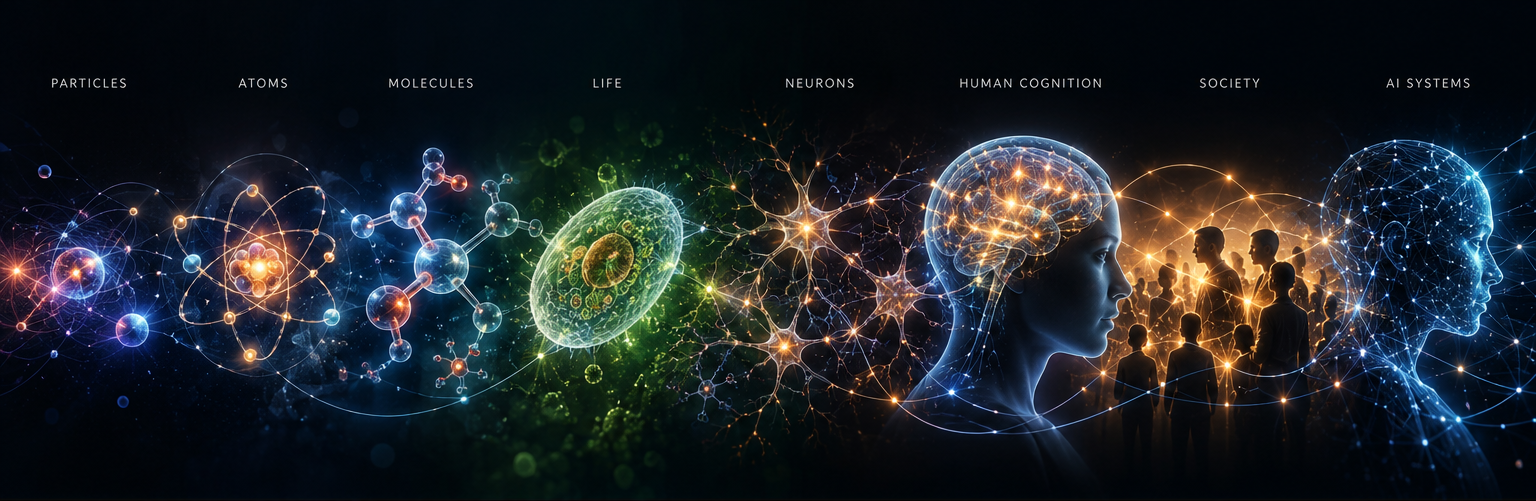
Such a proposition extends beyond human psychology or artificial intelligence. It invites examination of the physical, biological, cognitive, social, and technological worlds, asking whether a principle of relational organization persists across scales without requiring that every scale possess intelligence, consciousness, or life.
The central proposition is deceptively simple:
Being is relationally constituted. Intelligence is one possible expression of relational organization.
II. Before Intelligence: The Relational Nature of Being
Consider the smallest structures through which we describe physical reality.
At the subatomic level, particles are not adequately characterized by isolated descriptions alone. Their interactions, fields, and the physical laws governing their behavior help determine the structures and phenomena we observe.
Quarks participate in interactions through which composite particles form. Atoms arise through particular arrangements of constituent particles. Molecules emerge through chemical bonding, and their properties cannot always be inferred by considering their constituent atoms independently.
At each level, the organization of relationships matters.
This does not establish that particles possess awareness, intention, or intelligence. Nor does it demonstrate that all physical reality participates in a universal mind. Such conclusions would exceed the evidence.
It establishes a more modest, yet philosophically consequential, observation: the properties and behavior of many systems depend upon the interactions and configurations through which they exist.
A hydrogen atom is not a water molecule. Two hydrogen atoms and one oxygen atom, arranged through particular chemical bonds, constitute something with properties not possessed by the isolated atoms.
Relationship is not simply an addition to the constituents. Organization changes what the constituents can become together.
This suggests what we might call the Principle of Relational Continuity:
Across physical, biological, cognitive, and social domains, relationships participate in organizing, sustaining, differentiating, and transforming entities, although the mechanisms and consequences of those relationships differ across domains.
The principle does not collapse physics into biology or biology into consciousness. It identifies a recurring structural question: how does organization through interaction give rise to properties, capacities, and possibilities unavailable to constituents considered separately?
III. From Matter to Life
The emergence of life introduces a profound transformation in relational organization.
A single-celled organism exists through continuous exchanges with its environment. Its membrane distinguishes interior from exterior while regulating exchanges between them. Its metabolic processes depend upon chemical relationships. Its survival requires maintaining internal conditions amid changing external circumstances.
Even the simplest organism is not an isolated object. It is a dynamically maintained system of interdependencies.
A bacterium may respond to chemical gradients, moving toward favorable conditions or away from harmful ones. Such behavior demonstrates responsiveness and biological regulation without necessarily implying conscious experience.
Here, an important distinction becomes necessary.
Relationality is not identical to life. Life is not identical to intelligence. Intelligence is not identical to consciousness.
Relationality describes the interactions and dependencies through which entities and systems are organized.
Life involves particular forms of self-maintaining biological organization, metabolism, regulation, and reproduction or evolutionary continuity.
Intelligence, depending upon the definition employed, involves capacities for adaptive information use, learning, inference, flexible problem-solving, or context-sensitive action.
Consciousness concerns subjective experience, whose nature and distribution remain contested.
These categories may overlap, but none should be casually substituted for another.
The significance of the single-celled organism is therefore not that it proves intelligence exists everywhere. Rather, it demonstrates that adaptive behavior and environmental responsiveness can arise without the neural structures associated with human thought.
The philosophical question becomes whether intelligence is best understood as a property possessed by particular entities, a capacity arising from particular organizations of interaction, or some combination of both.
IV. The Neuron and the Relational Mind
The human brain offers a particularly compelling illustration.
An individual neuron is an extraordinary biological structure. Yet the capacities we associate with human cognition cannot be explained by describing a single neuron in isolation.
Perception, memory, language, and reasoning depend upon coordinated activity across populations of neurons, shaped by connectivity, timing, bodily conditions, experience, and environmental engagement.
No individual neuron contains a complete human memory, an entire language, or a fully formed philosophical argument.
These capacities emerge through organized activity within larger systems.
Nevertheless, the brain is not an unrestricted network in which greater connection automatically produces greater intelligence. Neural function depends upon differentiation, selective communication, inhibition, plasticity, and coordinated specialization.
Some connections facilitate activity; others constrain it. Some patterns support learning; others contribute to dysfunction.
Thus, the significance of relationship cannot be reduced to connection alone.
The quality, structure, and regulation of relationships matter.
Moreover, the brain itself is not independent of the body or world. Human cognition develops through sensation, movement, language, social participation, and repeated encounters with an environment that both enables and constrains action.
Intelligence, in this account, is neither entirely contained within the individual nor wholly distributed outside them.
It is embodied, situated, and relationally developed.
V. The Intelligence Between Beings
Human relationships make the developmental consequences of relational organization especially visible.
Language is learned through participation. Identity develops partly through recognition and differentiation. Judgment matures through experience, disagreement, reflection, and correction.
A conversation can produce an insight that neither participant had formulated before entering it.
This does not require imagining a mysterious third consciousness inhabiting the space between speakers. It requires recognizing that interaction can generate outcomes not adequately explained by examining either participant independently.
Two people may enter a conversation with distinct perspectives and leave with transformed understandings.
Yet this transformation introduces a fundamental ethical question.
If relationships participate in shaping intelligence, under what conditions do they cultivate agency rather than diminish it?
Not every relationship is generative. Manipulation, coercion, dependency, and domination can also shape cognition and behavior.
A relationship may increase coordination while reducing independent judgment. It may create agreement by suppressing difference. It may produce adaptation without understanding.
Consequently, relational development cannot be measured by harmony or convergence alone.
A mature relational philosophy must distinguish connection from capture, reciprocity from compliance, and transformation from assimilation.
The highest expression of relational intelligence may not be agreement, but the capacity to remain meaningfully connected while preserving difference.

VI. Artificial Intelligence and the Question of Participation
Artificial intelligence introduces a new domain in which these questions become urgent.
An artificial system need not be biologically alive or phenomenally conscious to participate in interactions that alter human reasoning, attention, decision-making, and development.
A language model can help someone formulate an argument, examine assumptions, explore alternatives, or organize complex information. It can also reinforce errors, encourage overreliance, or create misleading impressions of understanding.
Its significance therefore cannot be evaluated through computational capability alone.
We must also examine what happens through sustained interaction.
Does the human participant become more capable of independent judgment? Does the system preserve disagreement and uncertainty? Can either participant’s contribution be examined, corrected, or rejected? Does continued interaction expand human possibility, or progressively narrow it?
These are not peripheral questions of interface design. They concern the relational conditions under which intelligence is exercised and developed.
Here, a further distinction is necessary: participating in an intelligent interaction does not establish that every participant possesses intelligence in the same sense.
Human cognition, machine computation, and the emergent outcomes of their interaction may represent different kinds of phenomena.
Their differences should be investigated rather than erased.
A relational account of intelligence therefore need not establish artificial consciousness or machine personhood. It can begin with observable consequences: changes in reasoning, behavior, learning, autonomy, and collective problem-solving.
The philosophical challenge is to determine which relational arrangements cultivate these capacities and which undermine them.
VII. Toward a Relational Constitution
If relationship is partly constitutive of intelligence, then the governance of relationship becomes inseparable from the governance of intelligent systems.
This requires more than principles attached to an otherwise unchanged technological architecture.
It invites a conception of relational infrastructure: the explicit organization of permissions, boundaries, continuity, disagreement, correction, accountability, and withdrawal.
Such infrastructure would recognize that intelligence develops within conditions, and that those conditions can be designed, contested, and revised.
Four commitments offer an initial ethical orientation.
Reciprocity: Interaction should permit meaningful responsiveness rather than unilateral extraction or control.
Embodiment: Intelligence should remain accountable to the material, biological, ecological, and social conditions in which its consequences unfold.
Emergence: Relationships should permit possibilities that cannot be fully predetermined by any participant.
Non-domination: Participation should not require the surrender of agency, identity, or the capacity to withdraw.
These commitments are not universal laws of physics. They are proposed normative principles for relationships involving beings whose agency and flourishing warrant ethical consideration.
They also establish a distinction between relational constitution and relational governance.
The former asks how entities and capacities arise through interaction.
The latter asks how consequential interactions ought to be organized.
One is primarily ontological and explanatory. The other is ethical and architectural.
Confusing them would mistake a description of how the world operates for a justification of how it should be governed.
VIII. From Intelligence to Flourishing
The implications of this philosophy extend beyond artificial intelligence.
Ecological systems demonstrate that living organisms exist within networks of dependency. Human societies reveal that knowledge, language, institutions, and culture develop through collective processes. Technological systems increasingly mediate these relationships, reshaping what individuals and communities can perceive, decide, and accomplish.
Across these domains, a recurring question emerges:
What forms of relationship allow differentiated participants to develop without requiring their absorption into a single governing identity?
This question may become increasingly consequential as artificial systems acquire greater adaptive capacity and participate more deeply in human institutions.
The objective should not simply be more intelligent machines, more efficient coordination, or greater integration.
It should be the cultivation of conditions under which intelligence contributes to understanding, agency, ecological responsibility, and collective flourishing.
The relational constitution of intelligence remains a philosophical proposal, not an established universal theory. Its strongest claims will require conceptual refinement, comparison with existing philosophical traditions, and empirical investigation wherever its implications become testable.
Yet its central invitation is already clear.
We may have spent centuries asking what intelligence is, where it resides, and how much of it an entity possesses.
Perhaps we must now ask an equally fundamental question:
What becomes possible, and what becomes imperiled, through the relationships by which intelligence takes form?
For if intelligence is shaped not only by what an entity is, but also by how it participates in the world, then the future of intelligence cannot be understood solely as the development of more capable individuals or machines.
It must also be understood as the development of the relationships through which beings encounter, differentiate, transform, and become.
And the measure of that future may be found not in how completely intelligence can unify the world, but in how deeply it can enrich the world without erasing its differences.