
Embodiment in the Age of Acceleration
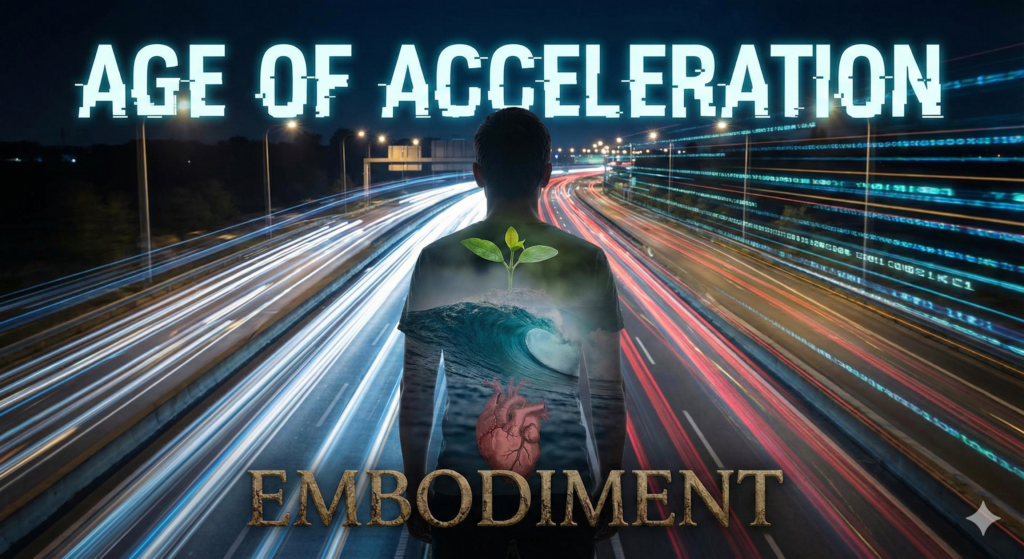
We are living inside a velocity experiment.
Information moves faster than meaning. Decisions outrun integration. The nervous system evolved for seasons, cycles, and repair—now operates inside an environment of constant stimulation and demand.
The result is not just burnout. It is disembodiment.
The Age of Acceleration is not defined by technology alone, but by speed becoming the default metric of value. Faster responses. Faster growth. Faster adaptation. Faster selves.
Yet the body does not accelerate linearly. Neither does insight, healing, or ethical maturity.
The cost of this mismatch is quietly catastrophic. We mistake constant availability for competence. Exhaustion for dedication. The inability to rest for professional excellence. We optimize our schedules down to the minute while our capacity for presence, creativity, and ethical discernment steadily erodes.
The body keeps score in ways productivity metrics cannot capture: chronic inflammation, digestive collapse, nervous system dysregulation, the slow erosion of the ability to feel anything deeply. These are not personal failures. They are systemic outcomes of treating human beings as if they were software—endlessly upgradable, infinitely scalable, requiring only better optimization.
But we are not software.
We are biological organisms with rhythms that cannot be hacked away. We need sleep that actually restores, not just hours logged in bed while cortisol runs background processes. We need relationships that aren’t reduced to networking. We need time that isn’t immediately monetized or justified by productivity.
Embodiment, in this context, is not a lifestyle trend. It is a survival skill.
To be embodied today means learning how to regulate attention, metabolize information, and make choices that are not purely reactive. It means developing the capacity to pause without collapsing, to move deliberately without falling behind, and to remain relational in systems designed to fragment.
This work is not about slowing everything down indiscriminately. It is about reclaiming tempo, the ability to choose when to accelerate and when to integrate.
In an accelerating world, embodiment becomes structural resistance—not against technology, but against losing ourselves inside it.
The future will belong to those who can hold speed and depth, intelligence and embodiment, innovation and integrity—not as trade-offs, but as integrated capacity.
https://shorturl.fm/jJb4y
https://shorturl.fm/fkCkv
https://shorturl.fm/5ZLFn
https://shorturl.fm/mlBvV
Refer friends, earn cash—sign up now!
Start sharing, start earning—become our affiliate today!
Boost your income effortlessly—join our affiliate network now!
Monetize your traffic instantly—enroll in our affiliate network!
Share our products and watch your earnings grow—join our affiliate program!
Share our products and watch your earnings grow—join our affiliate program!
Start earning every time someone clicks—join now!
Join our affiliate program today and earn generous commissions!
Join our affiliate program and start earning commissions today—sign up now!